
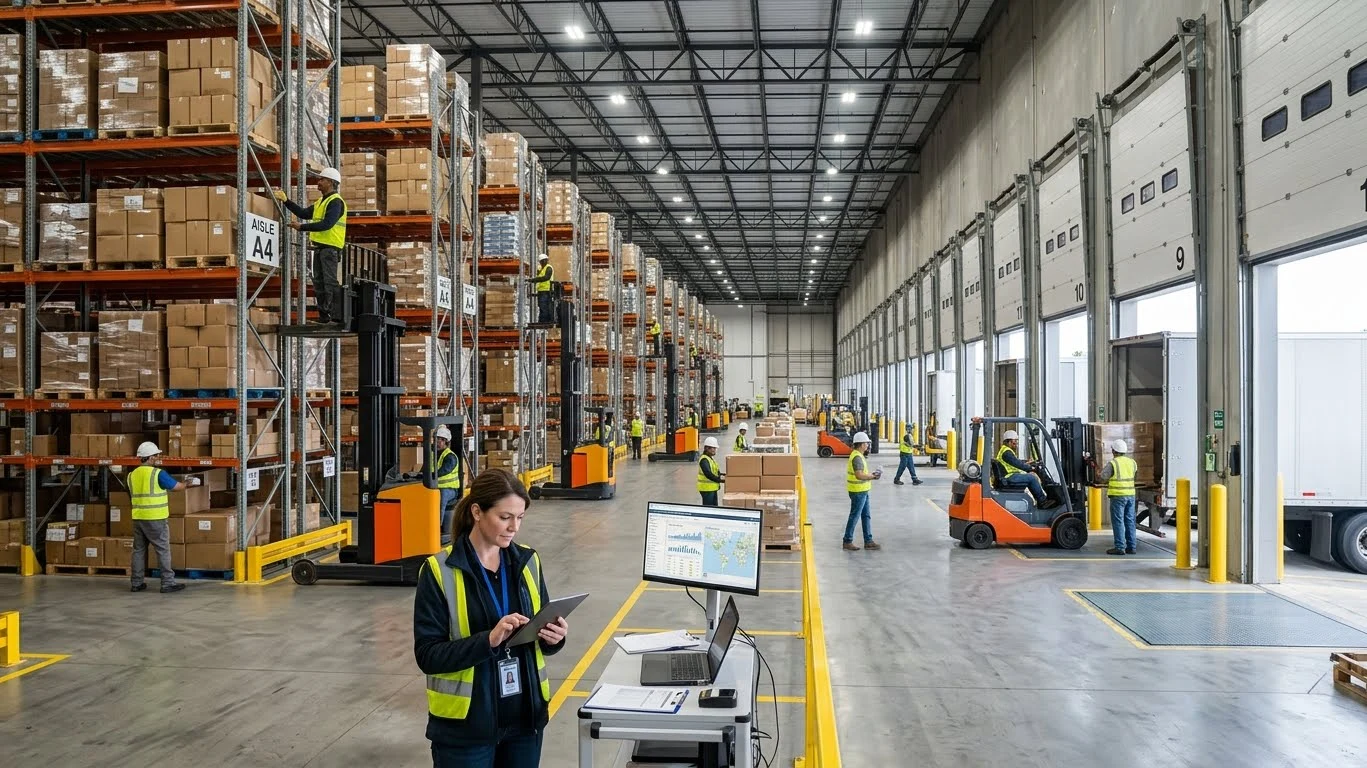
Warehousing and logistics are two connected but distinct parts of the supply chain. Warehousing is the storage and management of goods: receiving, organizing, and holding inventory until it’s needed. Logistics is the movement of those goods: planning, transporting, and delivering them from suppliers to customers. Warehousing keeps inventory ready; logistics gets it where it needs to go.
The two functions only create value when they’re coordinated. A warehouse that stores inventory perfectly but ships it slowly still fails the customer, and a logistics network that moves goods fast but pulls from a disorganized warehouse still causes delays. When warehousing and logistics are aligned, through shared data, synced technology, and a common location strategy, businesses get accurate, on-time deliveries at a lower cost.
The global warehousing and logistics market is on track to grow from $521.53 billion in 2025 to $646.26 billion by 2030, and companies that manage both well see measurably better results, up to 45% higher order fulfillment accuracy, according to CSCMP research. Below, we break down exactly how warehousing and logistics work together, what each stage costs, and the strategies top-performing companies use to get it right.
Understanding Warehousing and Logistics
Warehousing and logistics are key parts of the supply chain that ensure goods are stored, managed, and moved efficiently. Warehousing handles safe storage and organization of inventory, while logistics manages the movement of goods from suppliers to customers.
Together, they enable accurate, timely, and cost-effective deliveries. When both work well, businesses reduce delays, control costs, and consistently meet customer expectations.
What Is Warehousing?
Warehousing is the storage and management of goods until they are ready for distribution or sale. It includes organizing, tracking, and handling inventory to support efficient order fulfillment and smooth business operations.
What Is Logistics?
Logistics involves planning and moving goods through the supply chain, including transportation, tracking, routing, and delivery. It covers inbound flows from suppliers and outbound delivery to customers.
How Warehousing and Logistics Work Together
Warehousing and logistics work together to ensure efficient storage and timely delivery of goods. When aligned, they enable smooth movement of inventory from suppliers to customers with minimal delays.
The Role of Warehousing in Logistics and Supply Chain Management
Warehousing and logistics play a vital role in ensuring efficient, reliable, and cost-effective supply chain management. Companies that excel in inventory management and warehouse accuracy report up to 45% higher order fulfillment accuracy compared to competitors, according to industry research from the Council of Supply Chain Management Professionals (CSCMP).
Maintaining Inventory Availability
A well-managed warehouse maintains balanced inventory through accurate tracking, forecasting, and timely replenishment. Stockouts lead to lost sales and hurt reputation, while overstocking increases costs and locks up capital.
Supporting Order Fulfillment
Order fulfillment is driven by warehouse operations, from receiving an order to handing it over to a carrier. Picking, packing, labeling, and staging all happen inside the warehouse. When done efficiently, it improves delivery speed and reduces errors.
Improving Distribution Efficiency
Strategically located warehouses reduce delivery time and transportation costs by keeping inventory closer to customers. This gives businesses a strong competitive advantage in meeting demand faster and more efficiently.
Enhancing Customer Satisfaction
When products are stored, picked, and shipped accurately through reliable carriers and optimized routes, customers receive the right order on time. This consistency builds trust, encourages repeat purchases, and strengthens long-term customer loyalty.
Core Warehousing and Logistics Operations
Core warehousing and logistics operations ensure the efficient storage, handling, and movement of goods throughout the supply chain.
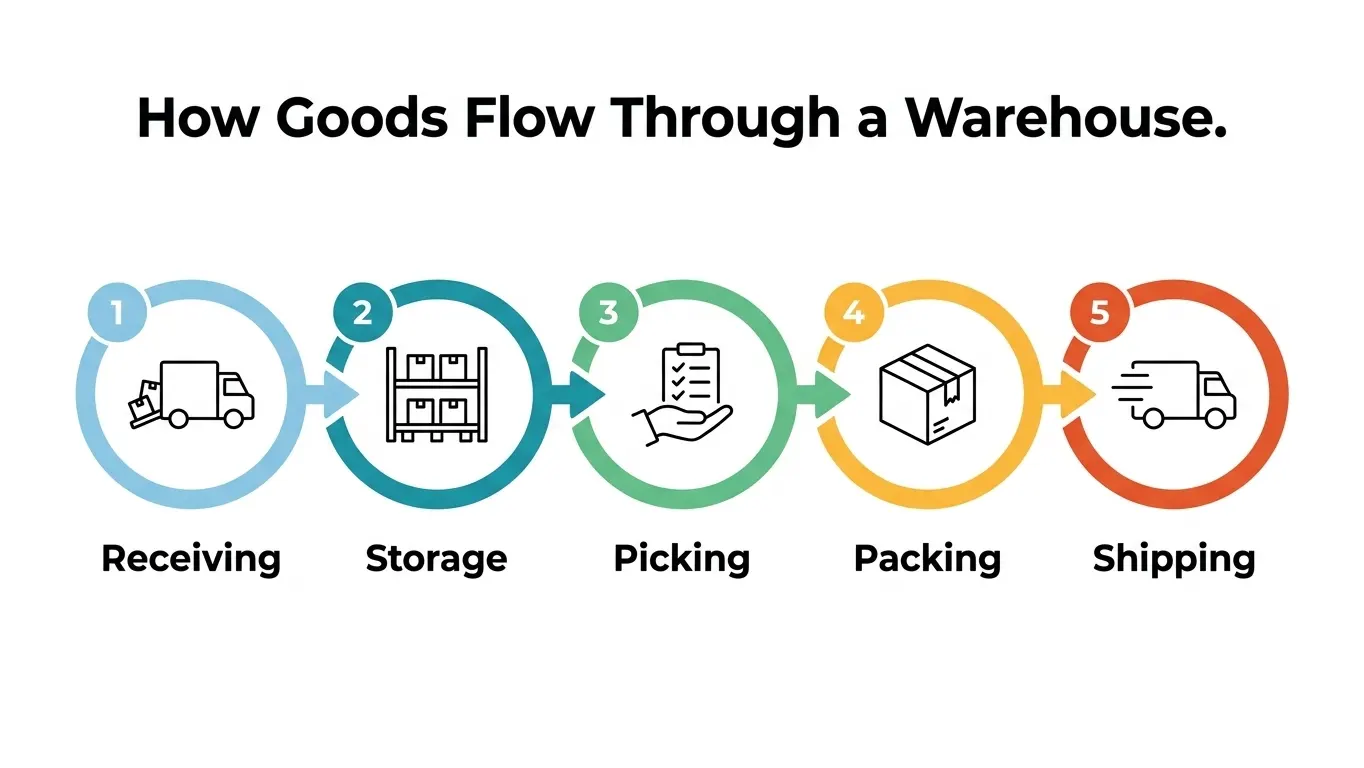
Receiving and Inventory Storage
When goods arrive, the receiving team checks quantities, inspects damage, records shipments, and stores items in assigned locations. Fast-moving items are placed near picking areas, while fragile or temperature-sensitive goods are stored appropriately.
Inventory Tracking and Control
Inventory control keeps product quantities and locations accurate through cycle counts, real-time updates, and regular reconciliation. If the system shows an item as available when it is not, it can cause delays in orders and lead to customer dissatisfaction.
Order Picking and Packing
A picker collects items using a WMS-generated pick list. The order then moves to packing, where it is verified, protected, and labeled for shipment. Picking and packing are key, labor-intensive steps prone to errors in fulfillment.
Shipping and Distribution
Once packed and labeled, orders move to the shipping dock where they are sorted by carrier, loaded, and dispatched. Transportation systems manage carrier selection, route optimization, and shipment tracking. This stage makes logistics performance visible to the customer.
Returns Management
Returns management involves receiving returned items, inspecting them, and determining whether they can be restocked or need to be discarded. Inventory is then updated accordingly. A smooth returns process helps reduce losses and improves the customer experience.
Cross-Docking: Where Warehousing and Logistics Truly Converge
Cross-docking is where logistic warehousing operations stop being separate functions and start working as one continuous process. Instead of storing goods for days or weeks, incoming shipments are unloaded, sorted, and immediately reloaded onto outbound trucks, sometimes within hours.
This works best for high-turnover products, perishable goods, and time-sensitive e-commerce orders where speed matters more than storage. A warehouse dock becomes a transfer point rather than a holding space.
Benefits of Cross-Docking:
- Reduces storage and handling costs by minimizing warehouse dwell time
- Speeds up delivery by cutting out unnecessary storage steps
- Lowers the risk of inventory damage from repeated handling
- Works well alongside Just-In-Time (JIT) inventory strategies, where businesses receive goods only as needed rather than stockpiling
For businesses managing seasonal products, fast-moving retail goods, or time-critical shipments, this style of logistic warehousing shows exactly how tightly storage and transportation need to be coordinated. A delay of even a few hours on the warehouse side can throw off an entire outbound delivery schedule.
Different Types of Warehousing Solutions
Different warehousing solutions provide flexible storage options designed to meet varying business needs, from short-term storage to large-scale distribution.
Public Warehouses
Public warehouses provide shared storage space for multiple businesses, offering flexible and cost-effective solutions without long-term commitments. They are ideal for seasonal demand or short-term storage needs.
Private Warehouses
Private warehouses are owned or leased by a single business, giving full control over operations. They are commonly used by large retailers and manufacturers with consistent, high-volume storage needs.
Bonded Warehouses
Bonded warehouses store imported goods until customs duties are paid, allowing businesses to defer payments until release into the domestic market. This helps improve cash flow for companies handling large imports.
Distribution Centers
Distribution centers focus on fast inventory movement rather than long-term storage. Products are quickly received and shipped out, helping reduce delivery times and transportation costs across a specific region.
Cold Storage Facilities
Cold storage facilities provide controlled temperature environments for refrigerated or frozen goods. They are essential for food, pharmaceutical, and agricultural products to maintain quality across the supply chain.
Specialized and High-Security Storage in Warehousing and Distribution Logistics
Some products need more than standard shelving. Food-grade bulk and racked storage keeps consumables compliant with handling regulations. Climate-controlled zones protect sensitive electronics, lab materials, and pharmaceuticals from temperature and humidity damage. High-value goods, such as electronics or luxury items, often require restricted-access, monitored storage areas with additional security protocols to prevent loss or theft. This level of specialization shows why warehousing and distribution logistics must be planned together rather than treated as separate operations, since the storage method directly affects how quickly and safely goods move to their next destination.
Automated Warehouses
Automated warehouses use robotics, conveyors, and storage systems to reduce manual work and handle high order volumes with greater speed and accuracy than manual operations.
Warehousing vs. Logistics: Key Differences
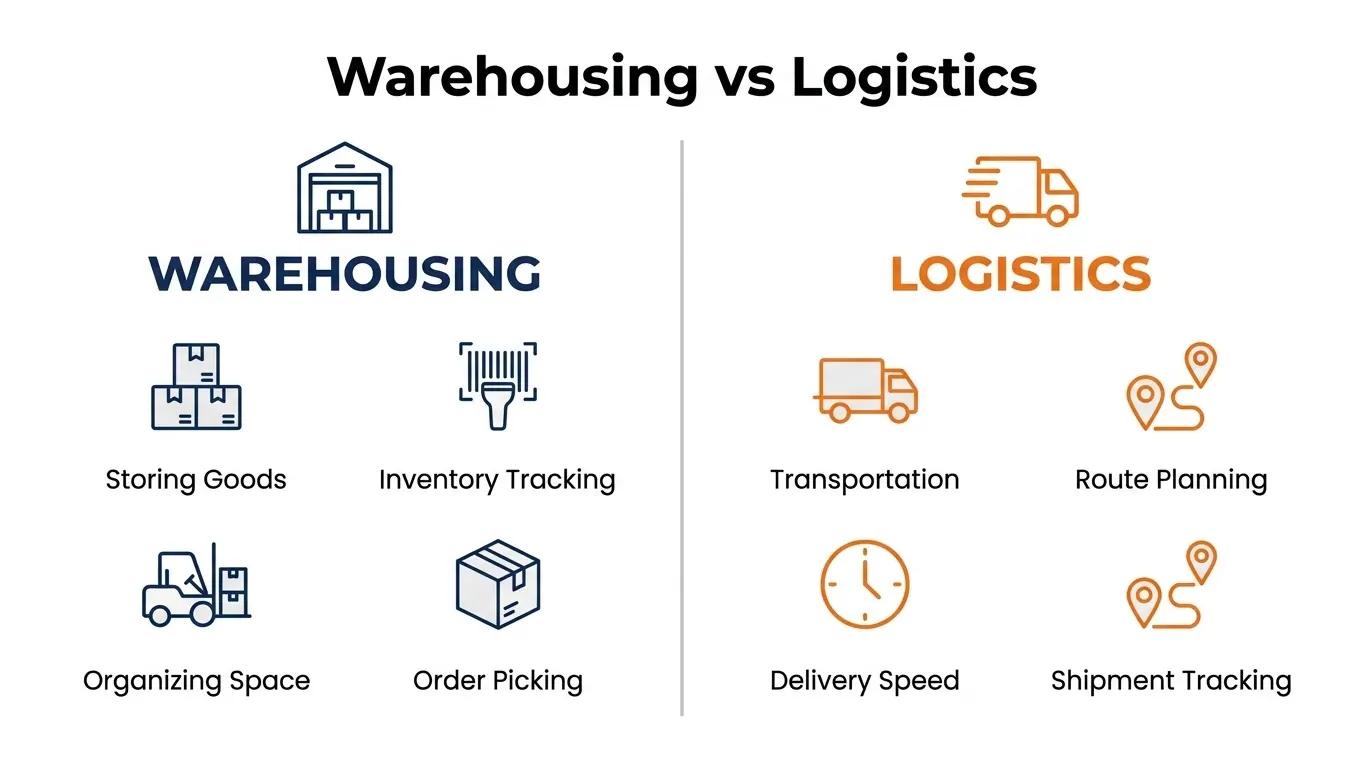
Warehousing focuses on storing and managing inventory, while logistics focuses on moving goods efficiently across the supply chain.
| Criteria | Warehousing | Logistics |
|---|---|---|
| Core Focus | Storing and organizing goods | Moving goods efficiently |
| Scope | Inside a facility | Entire supply chain network |
| Key Activities | Receiving, storage, picking, packing | Transportation, routing, delivery |
| Technology | WMS, barcode, RFID | TMS, route optimization, tracking |
| Cost Driver | Space, labor, storage efficiency | Fuel, carrier rates, distance |
| Primary Goal | Accuracy and space utilization | Speed and delivery reliability |
| Impact on Customer | Order accuracy | On time delivery |
Benefits of Effective Warehousing and Logistics
Effective warehousing and logistics improve efficiency, reduce costs, and ensure faster, more reliable delivery across the supply chain.
Reduced Operating Costs
Better space utilization lowers storage costs, smarter carrier selection reduces transport expenses, and fewer errors cut rework, reshipping, and customer service costs.
Faster Order Processing
Efficient warehouse layouts and data-driven carrier selection reduce the time between order placement and dispatch, resulting in faster delivery times.
Better Inventory Accuracy
Real-time tracking, accurate receiving, and regular cycle counts keep inventory records aligned with physical stock, preventing stockouts and ensuring reliable purchasing decisions.
Improved Scalability
Efficient systems handle higher order volumes without needing proportional increases in labor or space, allowing businesses to scale smoothly during peak demand without disrupting operations.
Stronger Customer Experience
Businesses that consistently deliver accurate and on-time orders build customer trust, encouraging repeat purchases and referrals.
How Warehousing and Logistics Adapt During Peak Season
Peak periods, such as the holiday season or major sales events, put warehousing and logistics under pressure at the same time. Order volumes spike, warehouse space fills faster, and carriers face capacity constraints.
Businesses that plan ahead typically increase temporary staffing and extend warehouse operating hours before demand peaks, pre-position inventory closer to key markets to reduce last-mile delivery time, secure carrier capacity in advance through contracts rather than relying on spot rates, and use real-time inventory data to avoid overselling out-of-stock items.
For e-commerce and DTC brands in particular, the ability to scale warehousing and logistics together during peak season, without sacrificing accuracy or delivery speed, often determines whether a business retains customers or loses them to slower competitors.
Technologies Used in Modern Warehousing and Logistics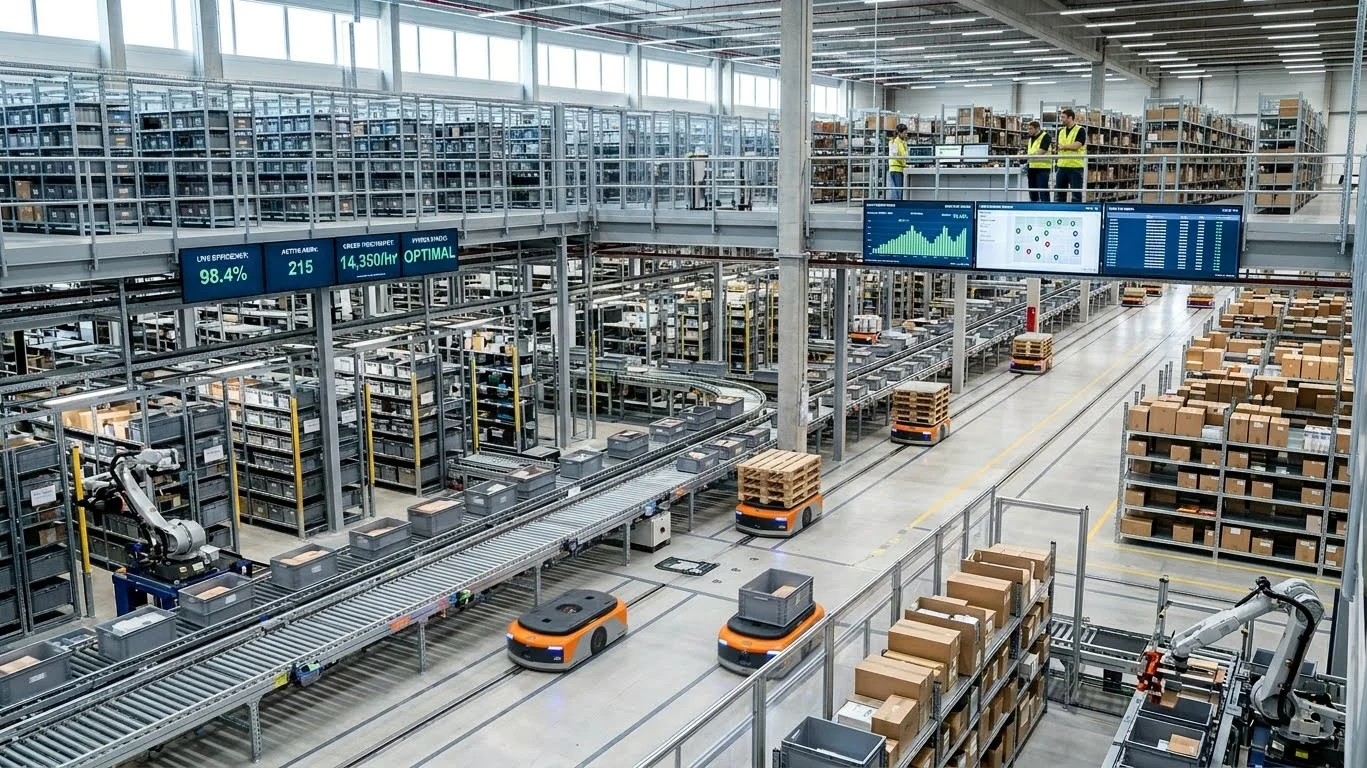
Modern warehousing and logistics use advanced technologies like WMS, automation, AI, and real-time tracking to improve speed, accuracy, and efficiency.
Warehouse Management Systems (WMS)
A WMS manages and coordinates all warehouse operations, including real-time inventory tracking, picking and packing workflows, receiving and shipping, and integration with order management and logistics systems.
Barcode and RFID Solutions
Barcode scanning and RFID technology enable real-time, accurate tracking of every product movement in the warehouse, reducing manual errors and maintaining precise inventory records.
Automation and Robotics
Warehouse automation uses conveyors, sorting systems, and autonomous robots to streamline operations. As costs decrease, it is becoming more accessible to mid-sized businesses that previously could not afford it.
AI-Powered Analytics
Artificial intelligence and machine learning enhance forecasting, optimize routing, predict equipment failures, and detect inefficiencies before they occur.
Common Challenges in Warehousing and Logistics
Warehousing and logistics face challenges such as inventory inaccuracies, rising costs, labor shortages, delivery delays, and safety and compliance requirements that can impact overall efficiency.
Inventory Inaccuracies
Inaccurate inventory data leads to wrong orders, missed shipments, and wasted space. Regular cycle counts, accurate receiving, and automated updates help prevent these issues.
Warehouse Space Constraints
Vertical storage systems, slotting optimization, and regular removal of slow-moving stock can significantly increase warehouse capacity without requiring physical expansion.
Labor Management Issues
High turnover, seasonal demand spikes, and the physical demands of warehouse work create ongoing challenges. Structured training, clear performance standards, and technology that reduces strain help improve workforce stability and performance.
Supply Chain Disruptions
Businesses that maintain safety stock, use multiple carriers, and implement contingency plans can recover from disruptions faster with less impact on customers.
Rising Transportation Costs
Data-driven carrier selection, route optimization, and shipment consolidation help businesses manage rising transportation costs more effectively.
Safety and Regulatory Compliance
Safety and compliance are core parts of any well-run logistics and warehouse operation. Facilities must follow OSHA safety standards, proper equipment handling protocols, and, for certain goods, regulatory requirements like FDA guidelines for food and pharmaceuticals. Regular staff training, safety audits, and updated equipment help reduce workplace incidents and keep operations compliant.
Best Practices for Optimizing Warehousing and Logistics
Best practices for optimizing warehousing and logistics include improving layout efficiency, using real-time data, adopting automation, and strengthening carrier partnerships.
Real-Time Inventory Visibility
Access to accurate, real-time inventory data benefits all teams involved in fulfillment by preventing duplicate orders, enabling proactive customer communication, and allowing faster resolution of discrepancies.
Efficient Warehouse Layout Planning
High-velocity products should be placed near packing stations, while frequently ordered items are stored close together. Regular layout reviews ensure the warehouse reflects current product mix and order patterns.
Accurate Demand Forecasting
Forecasting future demand helps businesses maintain optimal inventory levels, meeting customer orders without excess stock while reducing both stockouts and carrying costs.
Data-Driven Decision Making
Tracking key metrics such as order accuracy, pick rates, carrier performance, and on-time delivery helps businesses identify issues early and continuously improve overall performance.
Strategic Logistics Partnerships
Evaluating carriers based on performance data, maintaining relationships with multiple providers, and negotiating contracts aligned with cost and service standards all help improve logistics reliability over time.
How 3PL Warehousing and Logistics Services Add Value
3PL warehousing and logistics services add value by providing scalable infrastructure, advanced technology, and expert operations that improve efficiency and reduce costs.
Flexible Storage Capacity
Third-party logistics providers offer scalable storage capacity that adjusts with demand, allowing businesses to expand or reduce space as needed without committing to fixed facility sizes.
Transportation Network Access
Established 3PLs offer carrier networks, volume discounts, and advanced transportation technology that take years for individual businesses to develop. Partnering with a 3PL quickly improves both cost efficiency and delivery performance.
Cost and Resource Optimization
Outsourcing to a 3PL turns fixed infrastructure costs into variable operating expenses, freeing up capital and resources that can be focused on core business priorities.
How Warehousing and Logistics Costs Are Calculated
Understanding cost structure helps businesses budget accurately and compare warehouse and logistics providers fairly. Costs typically come from a few key factors. Storage costs are usually charged per pallet, per square foot, or per unit per month, depending on space and product type. Handling fees cover receiving, picking, packing, and labeling each order, often calculated per order or per unit. Transportation costs are based on distance, carrier rates, fuel surcharges, and shipment volume. Value-added services, such as kitting, custom packaging, or returns processing, add extra charges on top of standard fees. Some providers also require minimum volume commitments, meaning a minimum order or pallet volume, which can affect pricing for smaller businesses.
Costs vary significantly based on location, product type, and order volume, so businesses should request a detailed quote that breaks down each fee rather than a single flat number when comparing warehouse and logistics partners.
Choosing the Right Warehousing and Logistics Provider
Choosing the right provider involves evaluating scalability, technology, network reach, and reliability to ensure long-term operational efficiency.
Industry Expertise
An experienced provider understands your industry’s regulations, handling standards, and fulfillment requirements, enabling faster onboarding and fewer costly errors.
Technology Capabilities
Look for modern WMS platforms with real-time tracking and seamless integration with existing order management and e-commerce systems.
Geographic Reach and Transport Flexibility
A provider’s warehouse network should match your customer locations, as strategically placed facilities reduce delivery distances, speed up shipping, and lower transportation costs. Equally important in warehousing and transportation logistics is transport mode flexibility, meaning access to multiple carrier options, regional trucking fleets, and, when needed, rail or intermodal connections, so shipments aren’t limited to a single method that may not fit every order type or timeline.
Scalability and Support
A provider that scales with your business by adding capacity, services, and technology as your needs grow is a stronger long-term partner than one that only meets current requirements.
Local Market Knowledge (Southern California)
A provider, Logos Logistics Distribution, based in Southern California, like Ontario, CA, offers faster response times, regional carrier relationships, and proximity to major ports (LA/Long Beach) and highways, reducing transit time for businesses shipping across the West Coast.
Port Proximity and Bonded Warehousing Advantage
For businesses importing goods through the Ports of LA and Long Beach, the distance between the port and the warehouse directly affects total delivery time and cost, a key factor in efficient warehousing distribution logistics for West Coast businesses. A nearby bonded warehouse allows imported goods to be stored before customs duties are paid, giving businesses more flexibility on cash flow while goods clear customs. Once cleared, shorter drayage distances from port to warehouse reduce trucking costs and get inventory into distribution faster, an advantage that’s difficult to replicate from inland or out-of-state facilities.
Partner with Logos Logistics Distribution in Ontario, CA
If your warehousing and logistics are costing time, money, or customers, it’s time to switch. Logos Logistics Distribution provides end-to-end 3PL warehousing, fulfillment, inventory management, and distribution services across Southern California from Ontario, CA.
We help businesses reduce costs, improve productivity, and maintain speed and accuracy with scalable logistics solutions tailored to their needs. Contact us today to build a supply chain that works better for your business.
Conclusion
Warehousing and logistics aren’t separate back-office tasks. They’re one connected system. Warehousing keeps inventory accurate and ready; logistics gets it to the customer on time. Whether you call it warehousing and distribution logistics, warehousing and transportation logistics, or just supply chain management, the goal is the same: lower costs, fewer errors, and faster delivery.
The businesses that treat these functions as one coordinated process, not two departments working in silos, are the ones that scale without breaking, absorb peak-season demand without missing deadlines, and keep customers coming back. If your current setup is causing delays, errors, or rising costs, that’s usually a sign warehousing and logistics aren’t talking to each other the way they should.
Logos Logistics Distribution helps Southern California businesses fix exactly that, combining 3PL warehousing, fulfillment, and transportation into one system built around speed and accuracy. Contact us today to see how a coordinated warehousing and logistics strategy can lower your costs and speed up your deliveries.
Frequently Asked Questions
What Is the Purpose of Warehousing and Logistics?
Warehousing ensures products are stored safely, organized efficiently, and ready for orders, while logistics manages their movement from suppliers to warehouses and then to customers. Together, they form the foundation of an efficient supply chain.
How Do Warehousing and Logistics Improve Supply Chain Performance?
Strong warehousing improves accuracy and speed while lowering fulfillment costs, and strong logistics reduces transport costs and improves delivery reliability. Together, they create a more efficient supply chain with less waste.
What Is the Difference Between a Warehouse and a Distribution Center?
A warehouse is mainly used for storing inventory until it is needed, while a distribution center is focused on speed, moving goods quickly in and out to serve regional markets on shorter cycles.
What Technologies Are Commonly Used in Modern Warehouses?
Modern warehouses use warehouse management systems, barcode scanners, RFID, conveyors, robotics, and AI-driven analytics. The exact setup depends on facility size, order volume, and product type.
What Is the Difference Between Warehousing and Logistics?
Warehousing is the process of storing and organizing goods within a facility, while logistics is the broader system of planning and moving those goods from origin to destination. Warehousing keeps inventory ready and accessible; logistics ensures it reaches the customer efficiently. The two functions work together but serve distinct roles in the supply chain.
When Should a Business Outsource to a 3PL Provider?
Outsourcing makes sense when a business lacks capital for its own facilities, faces unpredictable demand, is expanding into new markets, or needs to refocus internal resources on core operations.