
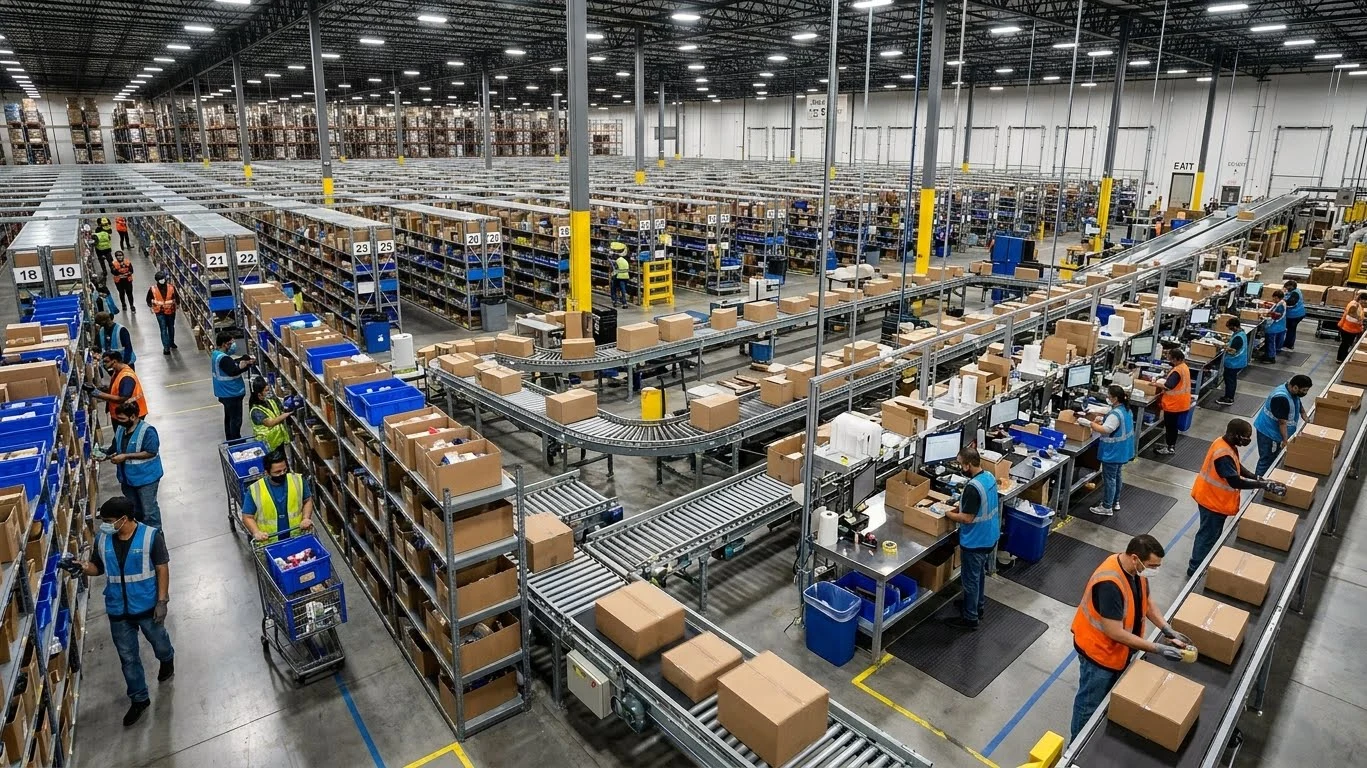
Pick and pack services are a key part of online order delivery. Workers pick the items from the warehouse and then pack them into boxes for shipping. This helps orders get delivered faster, makes the process simple, and helps businesses grow without needing their own storage space. Every time a customer clicks “buy now,” a clock starts ticking. They expect their order to arrive fast, in perfect condition, and exactly as described.
Behind the scenes, a lot has to go right for that to happen. One wrong item grabbed off the shelf, one box packed too loosely, one label printed with the wrong address, and the entire experience falls apart. That is why ecommerce brands based in Ontario, California and shipping across the United States rely on Logos Logistics Distribution to get every step right, from the moment inventory arrives at our warehouse to the moment a customer opens their box.
What Are Pick and Pack Services?
Pick and pack is exactly what it sounds like. When a customer places an order, someone in a warehouse locates the item on a shelf, picks it, packs it into a shipping box or mailer, and sends it out for delivery. It sounds simple, but at scale, it is one of the most complex and critical parts of the entire ecommerce supply chain.
Order Receiving: The process begins when a customer places an order through your online store. That order is sent to a warehouse management system, which generates a picking list.
Picking Items: A warehouse worker, or in some cases an automated system, locates each item in the warehouse and pulls it from its designated storage location. Grabbing the wrong size, color, or quantity at this stage creates problems that are very hard and costly to fix later.
Packing Orders: Protective materials like bubble wrap or air pillows are added when needed. The shipping label is printed and applied. Some fulfillment centers also include branded inserts, custom tissue paper, or personalized notes at this stage.
Shipping to Customers: The packed orders are then handed off to a shipping carrier, such as UPS, FedEx, or USPS, for final delivery. A tracking number is generated and sent to the customer.
How Pick and Pack Fulfillment Works
When your store connects to a fulfillment center, orders flow in automatically at checkout. The warehouse system assigns each order to a picker, generates the pick list, and tracks it until it ships. A well-run center keeps accurate, real-time stock counts, triggering alerts when items run low and flagging out-of-stock products before an order can’t be filled.
This prevents a major ecommerce pain point: selling products you no longer have. Real-time tracking also means you and your customers always know where an order is, from shelf to doorstep. That transparency builds trust and cuts down on “where is my order” support tickets.
Types of Picking Methods in Fulfillment Centers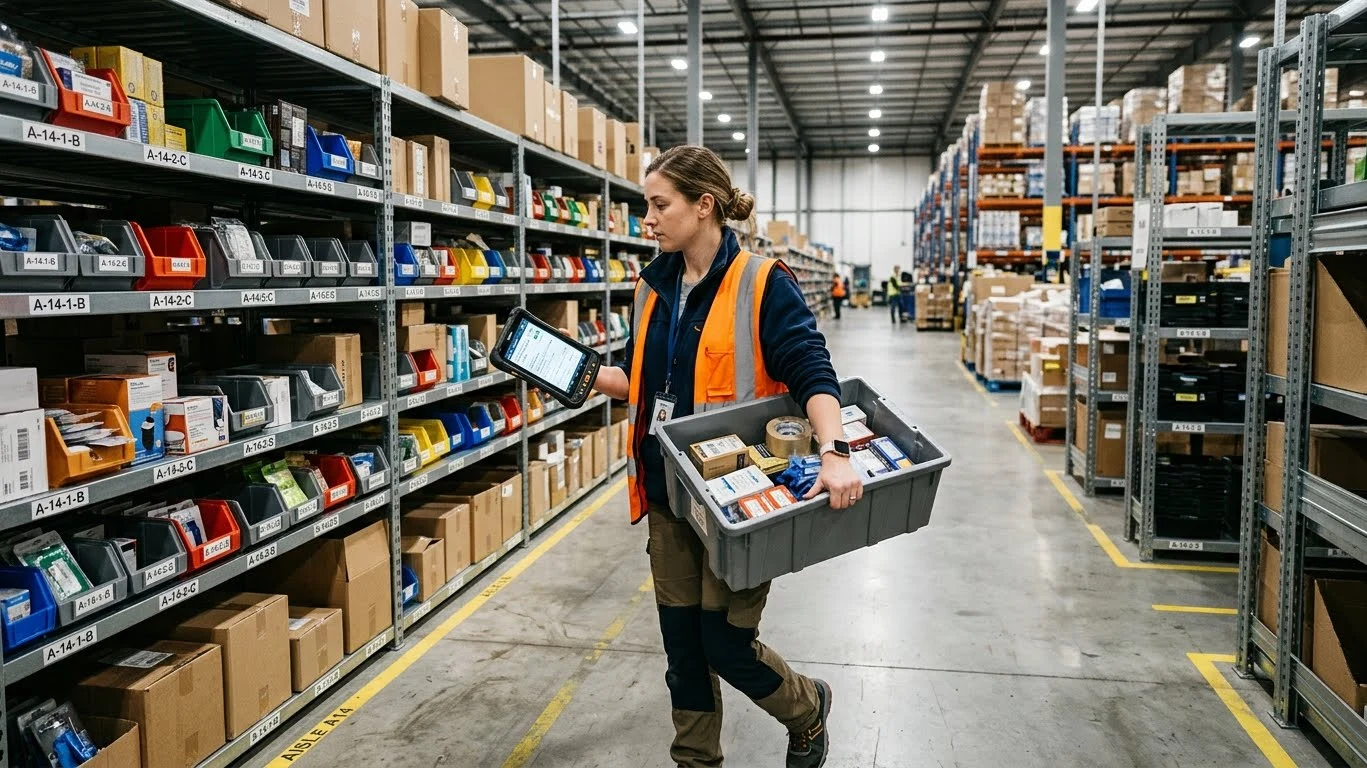
Not all warehouses pick orders the same way. The method used depends on order volume, the number of unique products being stored, and the layout of the warehouse.
Piece Picking
Piece Picking is the simplest method. One order is picked at a time. A warehouse worker takes a picking list for a single order, walks through the warehouse, collects each item, and brings everything to the packing station. This works well for small operations or brands with low order volumes, but it becomes slow and inefficient as the business grows.
Batch Picking
Batch Picking allows workers to pick items for multiple orders in a single trip through the warehouse. Instead of walking the same aisle five times for five different orders that all include the same product, a worker grabs all five at once. This cuts down on travel time significantly and increases how many orders can be processed per hour.
Zone Picking
Zone Picking divides the warehouse into sections, and each picker is responsible for only their assigned zone. When an order includes items from multiple zones, each picker handles their portion, and the order is assembled at a central packing station. This method is highly efficient for large warehouses with a wide variety of products.
Wave Picking
Wave Picking is the most advanced method. It combines elements of batch and zone picking and uses the warehouse management system to schedule picking in waves based on factors like order priority, carrier pickup windows, and SKU location. Large fulfillment centers with high daily order volumes use wave picking to maximize efficiency throughout the day.
Benefits of Pick and Pack Services
Faster Order Delivery Professional fulfillment centers are built for speed, allowing orders to be picked, packed, and shipped quickly often on the same day they are received.
Lower Shipping Costs Because 3PL providers ship large volumes daily, they can secure discounted carrier rates that help businesses save on shipping.
Improved Order Accuracy Barcode scanning and quality checks help reduce errors, leading to fewer returns and happier customers.
Scalability A pick and pack provider can easily handle increased order volumes, making it easier to grow without adding staff or warehouse space.
Better Customer Satisfaction Fast, accurate deliveries help create a positive customer experience, encouraging repeat purchases and positive reviews.
Pick and Pack vs Traditional Fulfillment
| Factor | Pick and Pack | Traditional Fulfillment |
| Process | Items picked individually from shelves and packed per order | Bulk inventory stored and shipped in larger, pre-packed quantities |
| Best for | Ecommerce, varied small orders, SKU-heavy catalogs | Wholesale, bulk B2B, predictable high-volume single-product shipments |
| Inventory storage | Items stored by SKU for easy individual access | Products stored in bulk pallets or cases |
| Order size | Small, mixed-item orders | Large, uniform orders |
| Speed | Fast for individual customer orders | Slower per-order, faster for bulk |
| Labor | More hands-on picking per order | Less picking, more bulk handling |
| Cost structure | Charged per item/order picked | Charged by volume or pallet |
| Scalability | Scales well with order variety | Scales well with volume, not variety |
| Accuracy needs | High many small picks increase error risk | Lower fewer, simpler picks |
| Customer fit | Direct-to-consumer (D2C) | Retailers, distributors |
Why Businesses Outsource Pick and Pack Services
The decision to outsource pick and pack fulfillment usually happens when one of three things becomes painful: the cost of running in-house fulfillment, the time it consumes, or the errors it produces.
Many businesses outsource fulfillment because it can lower costs, save time, and provide access to advanced warehouse systems. Instead of managing warehouse space, staff, shipping, and technology in-house, companies can rely on experienced 3PL providers and focus more on growing their business and serving customers.
Industries That Use Pick and Pack Services
Pick and pack fulfillment is not limited to one type of business. A wide range of industries rely on it every day.
Ecommerce and retail businesses of all sizes use pick and pack services as the backbone of their order fulfillment operation. Beauty and cosmetics brands depend on careful packing to protect fragile glass bottles and maintain brand presentation.
Apparel and fashion companies ship high volumes of clothing with size and color variants that require precise picking accuracy. Food and supplement brands often need fulfillment centers with climate-controlled storage and compliance with food-safe handling standards.
Common Challenges in Pick and Pack Operations
Even the best fulfillment operations face challenges. Knowing what they are helps you evaluate providers and ask the right questions.
Inventory Errors
Inventory errors are the most common problem. When stock counts in the system do not match what is actually on the shelf, orders get held up, wrong items get shipped, or customers receive backorder notifications after they have already paid. A good provider uses cycle counting and real-time inventory management to keep these errors to a minimum.
Delayed Shipping
Delayed shipping happens when orders are not processed fast enough to make carrier cutoff times, or when a provider does not have enough staffing to handle volume spikes. Ask any potential provider about their same-day processing cutoff and their average order processing time.
Seasonal Demand Spikes
Seasonal spikes catch underprepared fulfillment operations off guard. If a provider cannot staff up quickly for peak periods, your orders suffer. Ask about their capacity during Q4 and how they handle sudden volume increases.
Packaging Inefficiencies
Packaging issues like using boxes that are too large waste money on both materials and dimensional weight shipping charges. A good fulfillment partner uses the right sized packaging for each order to keep costs down.
How to Choose the Right Pick and Pack Service Provider
Choosing the right pick and pack provider comes down to fit. Look for a partner whose warehouse location keeps your products close to your customers for faster, cheaper shipping, and whose technology integrates smoothly with your store and gives you real-time inventory visibility.
Check that their pricing is transparent with no hidden fees, that they can scale with your order volume during busy seasons, and that their accuracy rates and turnaround times hold up. Finally, read reviews and ask about support: a provider who communicates clearly and handles issues quickly will save you far more headaches than one chosen on price alone.
Why Choose Logos Distribution for Pick and Pack Services
Logos Distribution focuses on reliability, speed, and accuracy for ecommerce fulfillment. Their system ensures careful order verification to reduce errors and returns. The service is built to scale with your business as it grows, and fast delivery helps improve customer satisfaction and repeat purchases. The focus on fast delivery means your customers get their orders when they expect them, which keeps your reviews strong and your repeat purchase rate high.
Ready to Stop Packing Boxes and Start Growing Your Brand?
If your current fulfillment setup is slowing you down, costing you too much, or causing errors that hurt your customer experience, it is time for a change. Logos Logistics Distribution, based in Ontario California, offers reliable and scalable pick and pack fulfillment built specifically for ecommerce brands that are serious about growth.
We serve businesses across the United States with fast processing, accurate order verification, and carrier rates that save you money on every shipment. Contact us today and find out how we can take fulfillment completely off your plate so you can focus on what actually grows your business.
Conclusion
Pick and pack services are not just a logistics detail. They are a core part of the customer experience and a direct driver of whether an ecommerce brand succeeds or struggles. Getting fulfillment right means orders ship on time, arrive in perfect condition, and match exactly what the customer ordered. Getting it wrong means returns, refund requests, negative reviews, and customers who never come back.
Frequently Asked Questions
What is the difference between pick and pack and kitting?
Pick and pack means pulling items from storage and packing them as orders come in. Kitting means pre-assembling product bundles before any order is placed. Both services often work together inside a fulfillment center depending on what your business needs.
How much do pick and pack services cost?
Most providers charge a per-order fee that covers picking, packing, and basic materials. Storage and shipping are usually billed separately. Always ask for a full pricing breakdown upfront so there are no surprises on your invoice later.
How quickly can a pick and pack provider ship my orders?
Most fulfillment centers offer same-day shipping for orders placed before a daily cutoff, usually between noon and 3 PM. Ask any provider about their average processing time and how they handle orders during their busiest days.
Can pick and pack services handle my Shopify or WooCommerce store?
Most providers integrate directly with Shopify, WooCommerce, BigCommerce, and Amazon. Once connected, orders flow to the fulfillment center automatically the moment a customer checks out with no manual work needed on your end.
What happens if an order is picked or packed incorrectly?
A reliable provider will reship the correct item quickly and work to recover the wrong one. More importantly, good providers use barcode scanning and verification during packing to catch mistakes before the box is ever sealed.